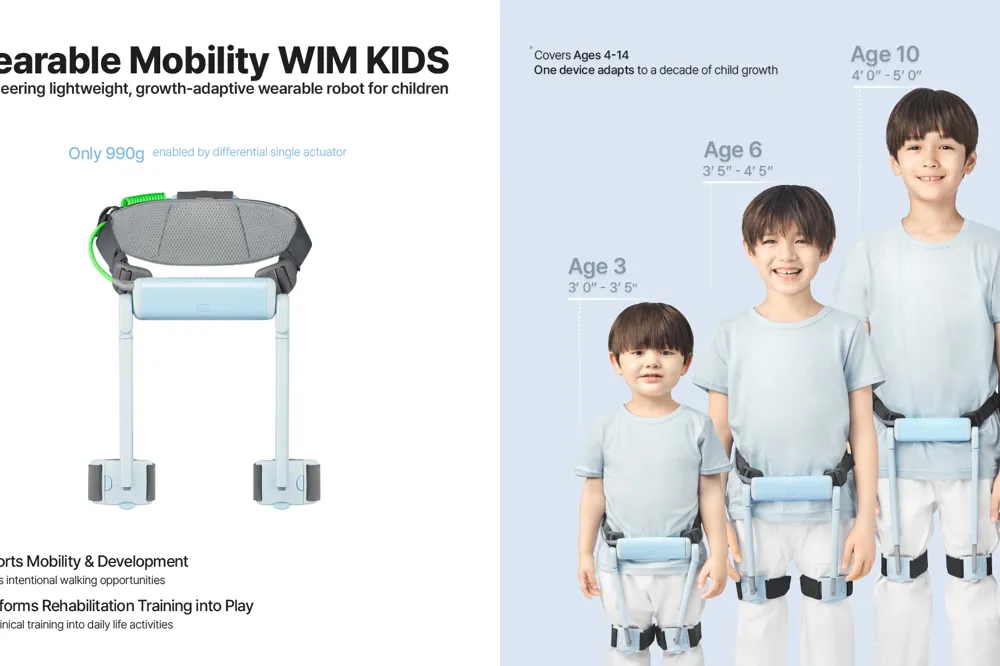
Lightweight wearable walking assistance robot for children with weakened lower bodies – A growth-adaptive robot weighing less than 1kg that monitors a child's gait in real-time and assists with motors, aiding in rehabilitation therapy and daily activities.
HonoreekoDigital HealthAI 피부 분석IoT 뷰티 디바이스텔레헬스피부 건강 관리개인 맞춤형 솔루션
WIM KIDS
7
0
WIRobotics
One-Line Product Definition
Problem Definition
Children who have difficulty walking due to muscular diseases or neurological problems have traditionally had to rely on wheelchairs, assistive devices, etc. However, these do not actively improve walking function, and it is difficult to prevent muscle weakness during growth.
Although adult-sized lower limb exoskeleton robots existed, there were few lightweight robots suitable for children's body types, so children could only practice walking to a limited extent in rehabilitation therapy rooms. In addition, children's body dimensions change as they grow, but existing assistive devices do not respond flexibly to these changes. As a result, the absence of a "dynamic solution to help children walk better on their own" was the problem.
Key Differentiators
WIM KIDS is a wearable robot that assists children's movements, achieving the world's lightest weight of 990g, significantly reducing the burden of wearing it. By adopting a Growth-Adaptive Frame structure, it can be adjusted to accommodate changes in leg length of children aged 4 to 15 without replacing modules, making it usable for a long period of time.
The robot has built-in sensor-based real-time motion tracking and a motor support algorithm that learns the child's walking pattern, provides motor assistance for insufficient strength, and maintains balance. This allows the child to practice walking confidently without worrying about falling, and gradually increase muscle strength by reducing robot assistance. In addition, there is an AI-based posture correction function to encourage the formation of correct walking habits.
In clinical trials, parents have provided feedback that "this robot makes my child feel the fun of walking alone and move actively," and its technical and design completeness is high enough to receive the CES Innovation Award for three consecutive years. Excellent lightness, growth-responsive design, and AI motion correction are major differentiators compared to other companies' products.
Key Adopters
For B2C, parents of children with walking disabilities can purchase directly or receive it through medical insurance/government support. In B2B, rehabilitation hospitals or treatment centers can purchase multiple units for patient treatment. In addition, special education schools or social welfare organizations may also adopt it.
Initially, institutional adoption is expected due to the high price per unit, but in the long term, it can become established as a home medical assistive device.
Scalability
WIRobotics has received global attention by winning the Innovation Award in the digital health field with this product, and is currently pursuing entry into the European and Chinese markets. In the future, it is possible to expand the lineup to include the WIM series for adult seniors or industrial wearable robots, and in fact, the same technology is being extended to walking assistance robots for the elderly (WIM S, etc.).
In terms of regulations, medical device certification is required, but since it is a new category compared to existing wheelchairs, proving safety and setting insurance benefits are challenges. However, the market outlook is bright as the demand for rehabilitation robots increases in an aging society. In addition, it meets the "Human Security for All (HS4A)" value and may be linked to various international support programs.
Technically, it is also possible to expand additional services such as providing walking analysis services by collecting robot data in the cloud, or adding fun elements by combining it with VR rehabilitation games.
Judges' Evaluation
At CES 2026, it was called "a new horizon for wearable robots for children" and won the Innovation Award in the digital health category. Industry experts praised it as a "harmony of technology and compassion," highly appreciating not only the technical completeness but also its contribution to improving the quality of human life.
At the actual CES stage, a demo of a child wearing the WIM KIDS robot and walking received great applause, and investors who saw this commented that it was "touching and had sufficient commercial potential." A robotics researcher at Carnegie Mellon University saw the concept of "a robot that grows with the child" as innovative, and there was praise for the weight reduction technology.
On the other hand, realistically, it is difficult to popularize it immediately due to the high price (expected to be in the tens of millions of won) and the still limited number of clinical cases, and the need for policy support such as health insurance coverage has been mentioned. Overall, the reaction at the CES site was very positive, and the comment that "it has taken a hopeful step in the field of children's rehabilitation" is impressive.
Analyst Insights
📌 Solution limited to a specific niche – While excellent in terms of technology and meaning, the target user base (children with walking disabilities) is limited and heavily dependent on the medical support system, so commercial success is expected to be achieved in the long term, focusing on the niche market.
The award list data is based on the official CES 2026 website, and detailed analysis content is produced by USLab.ai. For content modification requests or inquiries, please contact contact@uslab.ai. Free to use with source attribution (USLab.ai) (CC BY)
댓글 (0)
댓글을 불러오는 중...